




El Salvador’s Bitcoin strategy has been one of the most controversial and closely watched financial experiments in modern history. President Nayib Bukele, a well-known advocate of Bitcoin, has consistently increased the country’s Bitcoin reserves despite international skepticism. Now, even after securing a loan agreement with the International Monetary Fund (IMF), Bukele continues to stack Bitcoin, raising questions about how El Salvador is balancing traditional financial obligations with its commitment to cryptocurrency.
“This all stops in April.” “This all stops in June.” “This all stops in December.”
No, it’s not stopping.
If it didn’t stop when the world ostracized us and most “bitcoiners” abandoned us, it won’t stop now, and it won’t stop in the future.
Proof of work > proof of whining https://t.co/9pC0PoY3YQ
— Nayib Bukele (@nayibbukele) March 4, 2025
“We are going to keep buying Bitcoin. IMF deal or not, our strategy remains the same.” — Nayib Bukele Tweet
The IMF Loan Agreement and Its Implications
In early 2025, El Salvador reached an agreement with the IMF for a $1.4 billion loan aimed at stabilizing the country’s economy. This agreement was seen as a significant shift since the IMF has been vocal about its concerns regarding El Salvador’s Bitcoin adoption. Critics assumed the deal would require El Salvador to step back from its aggressive Bitcoin accumulation strategy. However, recent actions by the Bukele administration suggest otherwise.
Key details of the IMF loan agreement include:
Fiscal Stability Measures: Ensuring a balanced budget and reducing fiscal deficits.
Debt Management Reforms: Restructuring outstanding national debt to improve repayment capacity.
Financial Sector Strengthening: Improving banking oversight and anti-money laundering controls.
Transparency & Reporting: Regular financial disclosures to ensure accountability.
Despite these terms, Bitcoin remains a crucial part of El Salvador’s financial strategy.
Bukele’s Response to IMF Concerns
Bukele has maintained that Bitcoin is a long-term asset that will benefit El Salvador’s economy. He has dismissed the idea that the IMF agreement would restrict the country’s ability to buy Bitcoin. His stance was reinforced in a recent post:
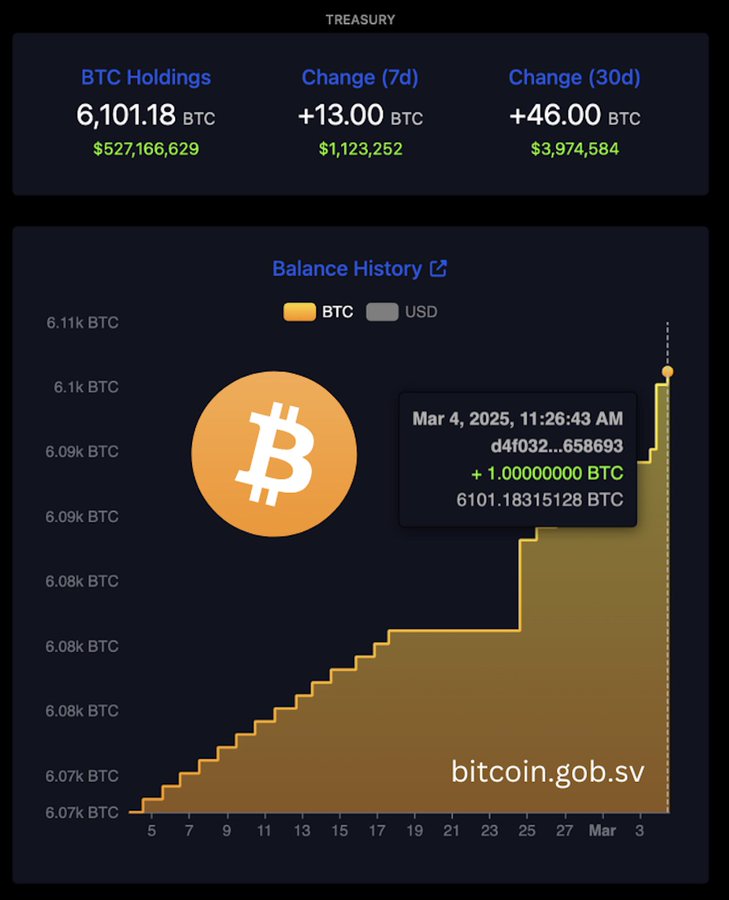
El Salvador buys another Bitcoin for its reserve on March 4. source— Bitcoin Office El Salvador
Bukele’s government has made it clear that Bitcoin adoption is non-negotiable, regardless of external pressure. By continuing to accumulate Bitcoin, El Salvador aims to position itself as a global leader in digital assets.
How Is El Salvador Funding Bitcoin Purchases?
While many expected the IMF deal to limit El Salvador’s Bitcoin purchases, Bukele’s administration has implemented creative strategies to continue stacking BTC without violating loan conditions.
1. Bitcoin Revenue from Tourism & Business Growth
El Salvador has experienced a surge in tourism due to its Bitcoin-friendly policies. The country has attracted international investors, digital nomads, and crypto entrepreneurs who bring in foreign capital. This revenue is helping finance ongoing Bitcoin acquisitions.
2. Volcanic Bond Initiative
El Salvador introduced the Volcanic Bond initiative, a Bitcoin-backed government bond designed to raise funds for infrastructure and further Bitcoin investments. These bonds allow the country to accumulate BTC without using IMF funds.
3. Bitcoin Mining from Renewable Energy
Bukele’s administration is expanding geothermal-powered Bitcoin mining using the country’s volcanic energy sources. Revenue from mining is reinvested into purchasing more Bitcoin, making the process self-sustaining.
4. Bitcoin Treasury Management
Rather than selling Bitcoin holdings, El Salvador is leveraging BTC for strategic financial operations. This includes using Bitcoin-backed credit facilities and holding BTC reserves for future appreciation.
Why Is Bukele Committed to Bitcoin Despite IMF Influence?
Bukele’s Bitcoin strategy is not just about short-term profits—it’s a geopolitical and economic play.
1. Economic Sovereignty
By embracing Bitcoin, El Salvador aims to reduce dependency on traditional financial institutions like the IMF and the World Bank. Bitcoin allows the country to operate outside the constraints of legacy financial systems.
2. Attracting Foreign Investment
Bitcoin adoption has positioned El Salvador as a global crypto hub. Investors and blockchain startups are flocking to the country, boosting its economy and creating jobs.
3. Long-Term Wealth Preservation
Bukele views Bitcoin as digital gold—an asset that will increase in value over time. By accumulating BTC now, El Salvador is betting on long-term economic gains.
4. Anti-Dollarization Strategy
El Salvador’s economy has been heavily dollarized, making it vulnerable to U.S. monetary policy. Bitcoin provides an alternative financial system that gives the country more control over its economy.
Concerns & Criticism
While Bukele’s Bitcoin strategy has supporters, critics continue to highlight potential risks:
1. Bitcoin’s Volatility
Bitcoin’s price fluctuations could impact the country’s financial stability. If BTC enters a prolonged bear market, El Salvador’s reserves may decline significantly in value.
2. IMF Relations
Although El Salvador secured an IMF deal, tensions remain. The IMF has previously warned about the risks of Bitcoin adoption, and future financial agreements may come with stricter conditions.
3. Public Debt Management
El Salvador still faces significant debt obligations, and some economists argue that focusing on Bitcoin instead of traditional economic reforms could be risky.
4. Liquidity Concerns
As Bitcoin is not as liquid as traditional currencies, using BTC for immediate economic needs can be challenging, leading to cash flow issues.
5. Global Regulatory Pressures
El Salvador’s Bitcoin strategy could face resistance from global financial regulators, potentially impacting trade and investment relations with major economies.
What’s Next for El Salvador’s Bitcoin Strategy?
Despite concerns, Bukele shows no signs of reversing course. Here’s what we can expect in the coming months:
- More Bitcoin Accumulation: The government will likely continue purchasing BTC through non-IMF funds.
- Expansion of Bitcoin Mining: Increased investment in renewable energy-powered mining operations.
- Continued Legal and Financial Innovations: Potential introduction of more Bitcoin-backed financial products.
- IMF Monitoring: The IMF will closely watch El Salvador’s financial management, but Bukele remains confident in his approach.
Bukele Plans to Continue Buying Bitcoin in Defiance of IMF
Final Thoughts
El Salvador’s ability to continue stacking Bitcoin despite the IMF loan agreement demonstrates Bukele’s unwavering commitment to financial innovation and economic independence. By leveraging tourism, Bitcoin bonds, mining, and strategic treasury management, El Salvador is proving that it can balance traditional financial commitments with its crypto ambitions.
While critics warn of risks, Bukele’s vision of a Bitcoin-powered nation is still unfolding, and the world will be watching closely to see whether his gamble pays off in the long run.

Hi, I’m Ahmed Falah. I work at the intersection of technology, finance, and human well-being, exploring how emerging digital systems can create sustainable and impactful growth across businesses and society.
As a senior author at Coinography, I write deeply researched content on blockchain ecosystems, tokenomics, decentralized finance, on-chain analysis, and the societal implications of Web3. My approach blends technical clarity with purpose-driven thinking, helping readers understand complex crypto concepts in a meaningful and accessible way.
Vision & Focus
Throughout my career, I have worked closely with hedge funds, enterprises, and high-net-worth investors, helping them navigate digital transformation and develop strategies rooted in data, transparency, and sustainable growth. I see technology not merely as a financial tool but as a foundation for creating healthier, more resilient organizations.
My writing focuses on a wide range of themes, including blockchain and decentralized financial models, token utility and ecosystem design, AI and blockchain convergence, the evolution of digital market infrastructure, purpose-driven and wellness-aligned leadership, and the future of work, finance, and organizational well-being.
I am deeply committed to building systems that empower individuals and support ethical innovation. My goal is to connect technology with human values and contribute to a future where digital ecosystems uplift people, communities, and businesses in meaningful and sustainable ways.
Professional Links
Website: https://coinography.com LinkedIn: https://ae.linkedin.com/in/ahmedfalah
Let’s Connect
If you’re interested in the future of blockchain, digital transformation, decentralized systems, or well-being-focused leadership, feel free to connect with me.























